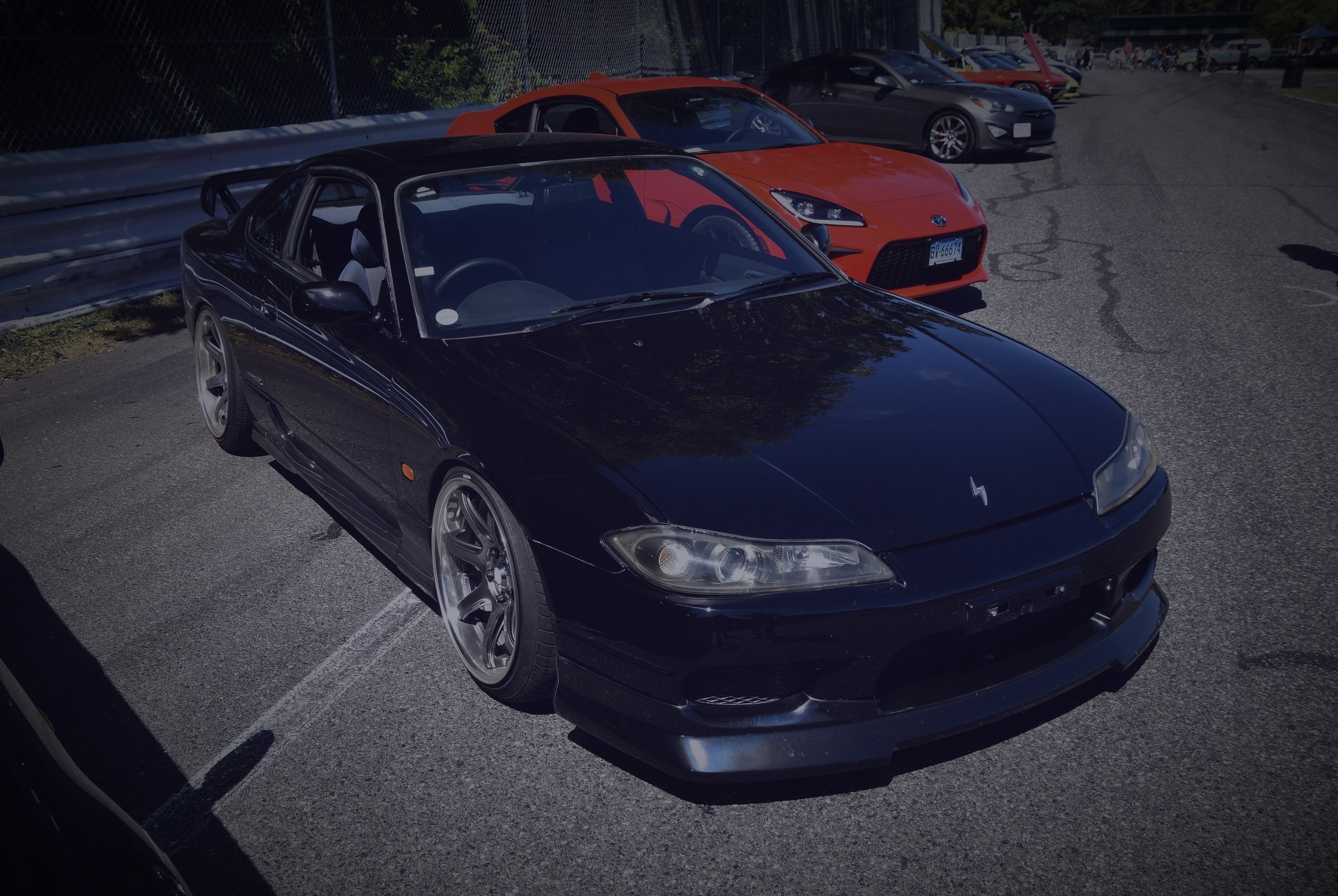
Photo: Charles from Port Chester, New York, CC0 1.0, via Wikimedia Commons. Colour graded.

Articles
The history of drifting starts on Japanese race circuits in the 1970s, moves to the mountain passes at night, and ends up as a judged motorsport with a world following. This article traces how that happened, who drove it, and why a handful of rear-wheel-drive Nissans and Toyotas ended up at the centre of it.
The name most often put at the start is Kunimitsu Takahashi. He began on motorcycles, and in 1961 became the first Japanese rider to win a motorcycle Grand Prix. After a crash in 1962 he moved to cars, racing on four wheels from 1965 (source 2). Wikipedia's article on him calls him the "father" of drifting; its article on drifting says he was the foremost creator of drifting techniques in the 1970s, though it marks that claim as needing a citation (sources 1, 2). The tyres of the time helped: Wikipedia notes that the bias-ply racing tyres of the 1960s to 1980s suited driving at high slip angles (source 1).
Keiichi Tsuchiya took an interest in Takahashi's technique and practised on Japan's mountain roads (source 1). He started racing in 1977 in the Fuji Freshman series, and in 1984 won six races there in an AE86 (source 3). He became known as the Drift King for drifting in races that were not about drifting (source 3).
In 1987, several car magazines and tuning shops agreed to make a video of Tsuchiya's driving. Known as Pluspy, it became a hit and inspired many later professional drift drivers (source 1). It also nearly cost him his racing licence, because of the illegal street driving it recorded (source 3).
The magazines followed. Wikipedia says one of the first drifting contests was run by Carboy magazine in 1986 (source 4). Option magazine's founder, Daijiro Inada, organised one of the first events made only for drifting, the Ikaten, with Tsuchiya as a judge. Wikipedia's articles disagree on the year, 1988 or 1989 (sources 1, 4). Option's Video Option series began in 1988 (source 4). In 2003, Tsuchiya published the Drift Bible, a guide to the core drifting techniques (source 3).
The Toyota AE86, built from 1983 to 1987, became what Road & Track, quoted by Wikipedia, calls a cult icon inextricably interwoven with the earliest days of drifting (source 5). Nissan's Silvia took over as the series turned professional: in the D1 Grand Prix seasons of 2003 to 2005, the S15 was the most common car in the field (source 1), and the car brought over for the first drifting demonstration in America, in 1996, was a 180SX (source 1). What they share is rear-wheel drive, which drifting is done in almost exclusively; Wikipedia adds that a mechanical limited-slip differential is considered essential (source 1).
After years of amateur contests, Inada and Tsuchiya ran a professional-level contest in 1999 and 2000 (source 4). The first event of what became the D1 Grand Prix was held at Ebisu Circuit in Fukushima in October 2000, and counted as the first round of the 2001 season (source 4). From the second round, drivers went head to head in pairs, the format called tsuiso (source 4). Judges score speed, angle, showmanship and the line taken through a corner (source 1). Nobuteru Taniguchi won the 2001 championship on S-tyres, which were banned after that season because they are not road legal (source 4).
One of the earliest recorded drift events outside Japan was Option's demonstration at Willow Springs in California in 1996, with Inada and Tsuchiya among the drivers (source 1). The D1 Grand Prix itself left Japan for the first time in August 2003, for an exhibition at Irwindale Speedway in California (source 6). When D1 declined to start an American series, Jim Liaw and Ryan Sage set up their own: they announced Formula Drift at the SEMA show in 2003, and its first round ran in May 2004 (sources 6, 7). D1 went on to an exhibition at Silverstone in Britain in 2005 and to Malaysia and New Zealand in 2006 (source 4), and Formula Drift Asia started in Singapore in 2008 (source 7). Wikipedia now lists national drifting series across North America, Europe, Asia and Australia (source 1).
Photo: Charles from Port Chester, New York, CC0 1.0, via Wikimedia Commons. Colour graded.
One short email when something new goes live. Nothing else.
No newsletter. Unsubscribe with one click.
