
Shinyaso
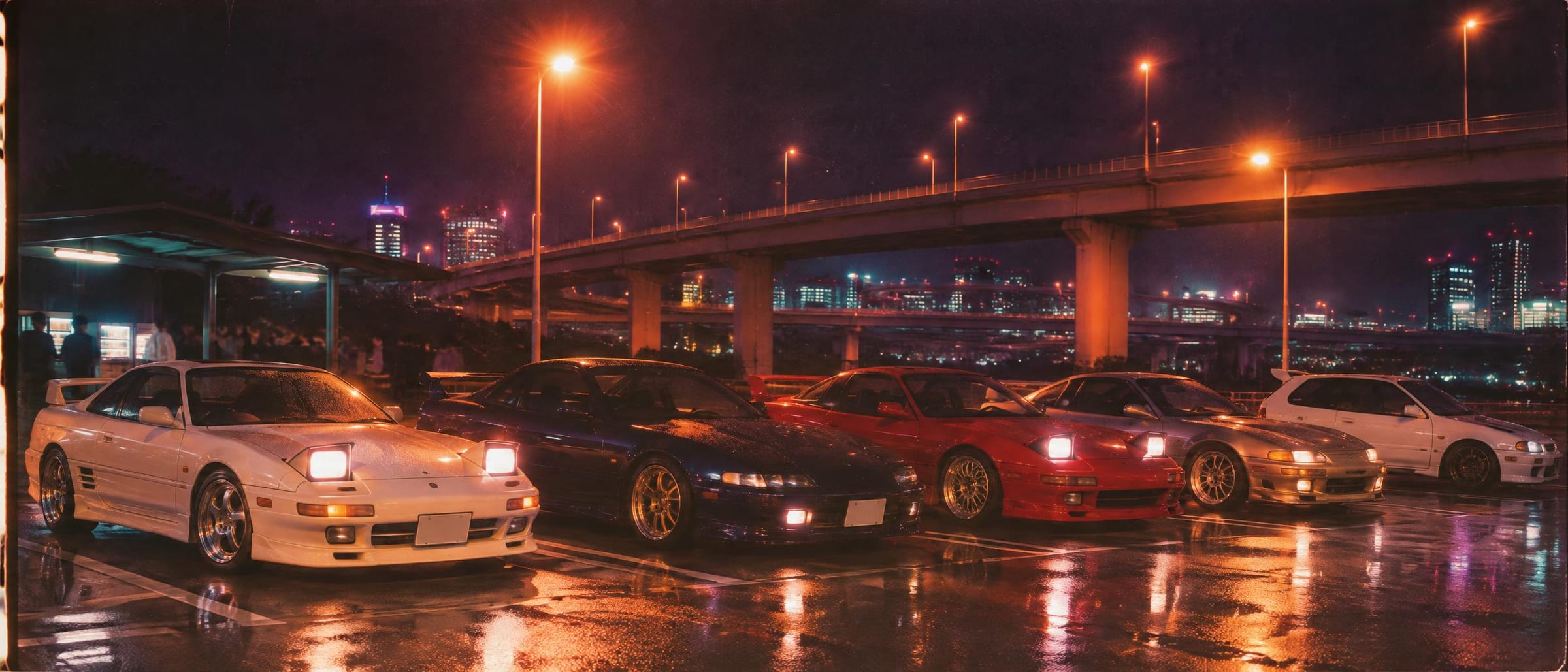
90s Japanese sports cars: the golden era
Where the money came from
Japan's asset bubble ran from 1986 to 1991 and burst in early 1992 (source 1). Many of the cars on this site were designed in those years and reached showrooms around the turn of the decade: the R32 GT-R in 1989, the NSX and the Mitsubishi GTO in 1990, and the A80 Supra in 1993 (sources 3, 7, 8, 9).
The 280 PS agreement
From the late 80s until 2004, Japan's carmakers held the advertised power of their home-market cars to 280 PS. It was a voluntary agreement, not a law (sources 10, 11). The cap shaped the whole era: with the headline figure fixed, engineers competed on everything else. Read the full article: The 280 PS agreement
The technology race
Twin turbochargers, all-wheel drive, four-wheel steering, active aerodynamics and electronically controlled suspension all reached road cars in these years. The Mitsubishi GTO of 1990 had every one of them (source 7).
How the world found out
The Skyline GT-R was built only in Japan, and Nissan sold it officially in just a few export markets: Hong Kong, Singapore, Australia and New Zealand from 1991, and Britain from 1997 (source 3). Racing put these cars in front of a wider audience, and so did the Gran Turismo games, first released in Japan in December 1997 with a GT-R and a Supra on the cover (source 12), and Initial D, a manga from 1995 and an anime from 1998 (source 13), along with imported magazines and videos.
The tuning scene
The cars arrived with strong engines and a cap on their advertised power, and tuner shops treated that as an invitation. Top-speed runs, circuit time attacks and drifting each grew their own shops, magazines and heroes: Top Secret, whose founder Smokey Nagata built cars for top-speed runs from 1994 (source 14), and Option magazine and Keiichi Tsuchiya, who turned drifting into a judged sport (source 15). Read more: A history of drifting
Why it ended
Buyers were moving away from sports cars (source 5), and in 2002 Japan's emissions rules tightened. Toyota says the Supra was dropped because meeting the coming exhaust emissions targets would have cost too much (source 5). The Skyline GT-R ended the same year, also because of emissions rules (source 16), and a Japanese report ties the Silvia's end to the same regulations (source 17). The RX-7's last edition, the Spirit R, went on sale in April 2002, and production ended that August (source 6).
Sources
- Wikipedia, "Japanese asset price bubble" (secondary source)
- Wikipedia, "Mazda RX-7" (secondary source)
- Wikipedia, "Nissan Skyline GT-R" (secondary source)
- Toyota, 75 Years of Toyota, vehicle lineage, "Supra" (second generation in Japan, 1993)
- Toyota UK Magazine, Joe Clifford, "History of the Toyota Supra", 19 October 2020, updated 6 July 2026
- Mazda newsroom, "Final limited edition of Mazda RX-7 'Spirit R' unleashed", 25 March 2002
- Mitsubishi Motors, "Car history"
- Honda Global, "The 1990s: trajectory of challenges"
- Wikipedia, "Toyota JZ engine" (secondary source)
- CarThrottle, Ryan Hirons, "The Japanese gentleman's agreement explained", 24 July 2024
- Wikipedia, "Japanese domestic market" (secondary source)
- Wikipedia, "Gran Turismo (1997 video game)" (secondary source)
- Wikipedia, "Initial D" (secondary source)
- Wikipedia, "Top Secret (company)" (secondary source)
- Wikipedia, "D1 Grand Prix" (secondary source)
- Nippon.com, Hiratsuka Naoki, "Nissan GT-R fades, Honda Prelude returns: the road ahead for Japanese sports cars", 2 December 2025
- Kuruma News, Keisuke Kaneda, "2002年の排ガス規制が運命変えた!? 絶版スポーツカー4選" (in Japanese: four discontinued sports cars and the 2002 emissions rules), 1 August 2022
- Honda Global, "The VTEC engine / 1989"
- Wikipedia, "Toyota MR2" (secondary source)
- Wikipedia, "Nissan Silvia" (secondary source)
- Wikipedia, "Honda Type R" (secondary source)
- Wikipedia, "Honda NSX (first generation)" (secondary source)
- Nissan press release, "Nissan releases all-new Silvia", 19 January 1999
- Wikipedia, "Mitsubishi 3000GT" (secondary source)
- Wikipedia, "Honda Integra" (secondary source)
Get an alert when a new model page or article goes live.
One short email when something new goes live. Nothing else.
No newsletter. Unsubscribe with one click.