
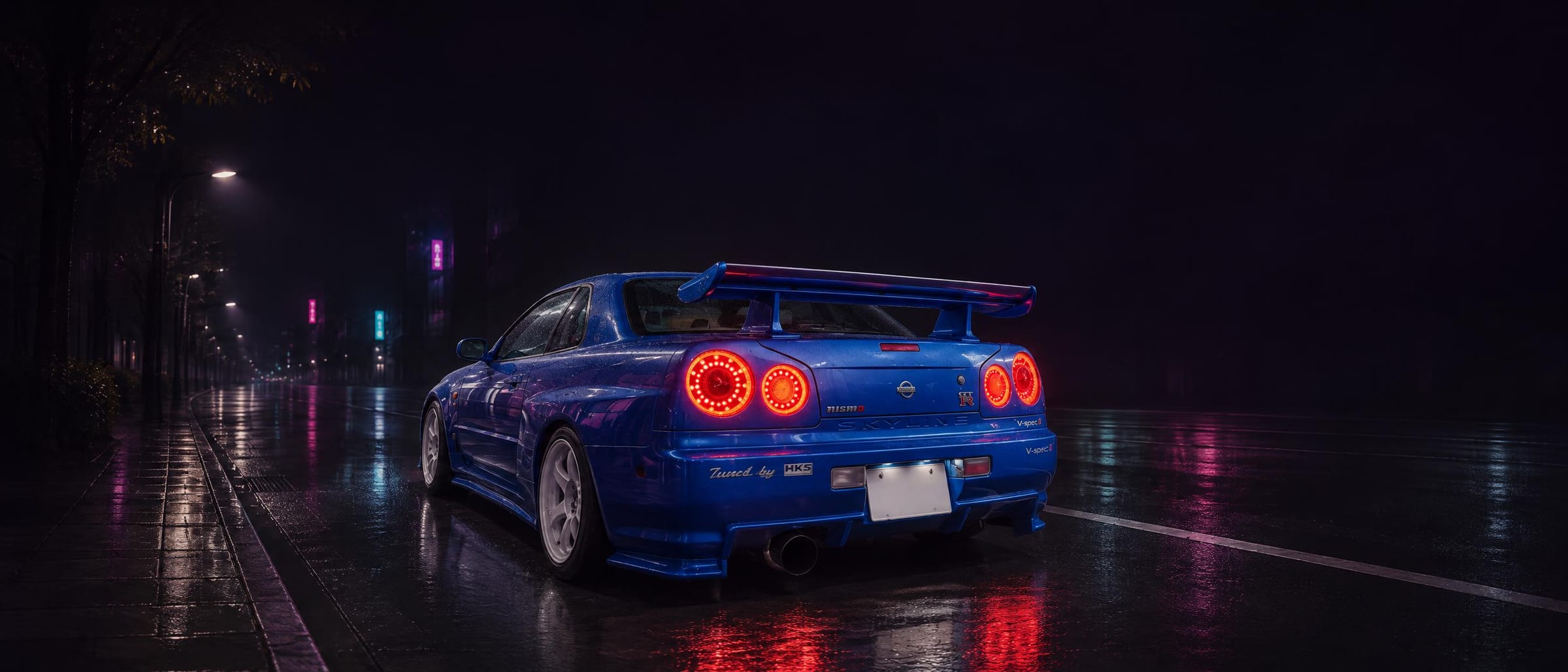
AI illustration based on a photo by David Kernan, CC BY 4.0, via Wikimedia Commons. Details may differ from the real car.

Nissan
Nissan Skyline GT-R
The Nissan Skyline GT-R came back in 1989 as the R32 and spent the next thirteen years as the benchmark. This page covers the GT-R's history from the first cars to the R35, with sourced specs, tuning and body kits for the R32, R33 and R34.
History
The first Skyline GT-R appeared in 1969 and built its name in Japanese touring car racing. A second generation followed in 1973 and was gone within months. The badge then rested for sixteen years.
The R32 revived it in 1989, built to win Group A racing. It paired the twin-turbo RB26DETT straight-six with the ATTESA E-TS all-wheel-drive system, and it dominated the Japanese championship so completely that the Australian press named it Godzilla.
The R33 followed in 1995 and the R34 in 1999, each keeping the RB26DETT. R34 production ended in 2002. The GT-R that arrived in 2007 dropped the Skyline name and the straight-six; it is part of the history here but outside this page's detailed specs.
- Nissan Heritage Collection, No.052: Skyline 2000GT-R (1969: PGC10)
- Nissan Heritage Collection, No.068: Skyline 2000GT-R (1973: KPGC110)
- Nissan Heritage Collection, No.210: Nissan Skyline GT-R (1989: BNR32)
- Nissan Heritage Collection, No.157: Skyline GT-R (1993: BCNR33)
- Nissan Heritage Collection, No.306: Skyline GT-R M-spec Nür (BNR34)
- Wikipedia, "Nissan Skyline GT-R" (secondary source: the Godzilla name, end of production, the R35)
Specs
Japanese-market figures first. Export differences are noted where they exist. Every figure links to its source.
| Variant | Chassis code | Years | Engine | Displacement | Induction | Power (PS / hp) | Torque (Nm) | Drivetrain | Gearbox | Kerb weight (kg) | Source |
|---|---|---|---|---|---|---|---|---|---|---|---|
| 2000GT-R | PGC10 | 1969 | S20 | 1,989 cc | Naturally aspirated | 160 / 158 | 177 | FR | 5-speed manual | 1,120 | [1][7] |
| Hardtop 2000GT-R | KPGC10 | 1972 | S20 | 1,989 cc | Naturally aspirated | 160 / 158 | 176 | FR | 5-speed manual | 1,100 | [2][7] |
| 2000GT-R | KPGC110 | 1973 | S20 | 1,989 cc | Naturally aspirated | 160 / 158 | 177 | FR | 5-speed manual | 1,145 | [3][7] |
| GT-R | BNR32 | 1989 | RB26DETT | 2,568 cc | Turbo | 280 / 276 | 353 | 4WD | 5-speed manual | 1,430 | [4] |
| GT-R | BCNR33 | 1995 | RB26DETT | 2.6 L | Turbo | 280 / 276 | 368 | 4WD | 5-speed manual | 1,530 | [7][8] |
| GT-R V-spec II | BNR34 | 2000 | RB26DETT | 2,568 cc | Turbo | 280 / 276 | 392 | 4WD | 6-speed manual | 1,560 | [5][7] |
| GT-R M-spec Nür | BNR34 | 2002 | RB26DETT | 2,568 cc | Turbo | 280 / 276 | 392 | 4WD | 6-speed manual | 1,580 | [6][7] |
- A dash means the source does not state that value.
- Years show the model year of the car each source documents, not the length of the production run.
- Power in hp is converted from the PS figure the source gives.
- Rows citing Wikipedia are from a secondary source, and Wikipedia gives no citation of its own for most of those figures.
- Nissan’s own pages give no drivetrain or gearbox. Those two columns come from Wikipedia, which states them per generation, not per variant.
- The R33 row rests on Wikipedia in English and Japanese, because no Nissan page for a road-going R33 could be read. Its torque is converted from 37.5 kgf·m. English Wikipedia gives the weight as 1,530 kg in one place and 1,540 kg in another.
- Nissan’s page for the M-spec Nür is headed 2000 but says the car was manufactured in 2002. The later year is used here.
- Nissan Heritage Collection, No.052: Skyline 2000GT-R (1969: PGC10)
- Nissan Heritage Collection, No.401: Skyline Hardtop 2000GT-R (1972: KPGC10)
- Nissan Heritage Collection, No.068: Skyline 2000GT-R (1973: KPGC110)
- Nissan Heritage Collection, No.210: Nissan Skyline GT-R (1989: BNR32)
- Nissan Heritage Collection, No.280: Skyline GT-R V-spec II (2000: BNR34)
- Nissan Heritage Collection, No.306: Skyline GT-R M-spec Nür (BNR34)
- Wikipedia, "Nissan Skyline GT-R" (secondary source: drivetrain and gearbox per generation)
- Japanese Wikipedia, "日産・スカイラインGT-R" (secondary source)
Spotted a figure you can correct, with a source? Email daansimpelaar6@gmail.com.
Tuning
The RB26DETT was designed with racing in mind, and tuners have spent three decades finding out what that means. This section covers the engine's strengths and its documented weak points, and how the all-wheel-drive system shapes what a tuned GT-R can do.
Most of what follows comes from tuners, parts makers and magazines rather than the carmakers, and several of those sources sell the parts they describe. Each point names its source. Power is given in the unit the source uses, and figures "at the wheels" are lower than figures at the engine.
- Gaskets before boost. Tomei, which makes turbochargers for the engine, names the head gasket as the RB26DETT's first weak point, with the intake manifold, exhaust manifold and throttle body gaskets close behind, and advises metal gaskets at the very least before boost goes up. With those, it puts the engine at 500 PS on its own T550B turbos at 1.1 to 1.2 kg/cm² (15.6 to 17.1 psi). (source 1)
- The limits Tomei gives. Stock pistons: about 500 PS; forged pistons allow 1.5 kg/cm² (21.3 psi). Connecting rods: a weak point, to be replaced above about 550 PS. Camshafts: change them above 1.4 kg/cm² (19.9 psi). Airflow meters: about 400 PS. The stock blow-off valves also leak boost at high pressure. (source 1)
- Oil and revs. Oil pump failure is a known RB26 risk, and an uprated pump is a priority once power goes up, along with an oil cooler. Option Motorsport found the crankshaft visibly shaking above 7,200 rpm, so Drifted advises a crank damper and a limit of about 7,000 rpm. (source 2) Nissan's own N1 engine for the R34 points the same way: it had uprated oil and water pumps, stronger pistons, rods and rings, and all-steel turbine wheels in place of the standard steel and ceramic ones. (source 3)
- What ATTESA E-TS does with more power. The system sends between 2 and 50 percent of the torque to the front wheels. An R32 can run almost entirely rear-drive; R33s and R34s always keep about 10 percent at the front. The controller reads its sensors 10 times a second on the R32, 100 on the R33 and 1,000 on the R34. Above about 680 Nm (500 lb-ft), the life of the factory front differential is in question, and the R32's has half the spider gears of the later cars. Re-stacking the transfer case clutches takes it to roughly 880 to 950 Nm (650 to 700 lb-ft). Aftermarket torque-split controllers and upgraded G-sensors change how the split is decided. (source 4)
- R34 points. The Getrag six-speed is known to jump out of first, and regular oil changes help it last. Super HICAS works above 80 km/h (50 mph), and some racers removed it. Vacuum lines, coil packs and airflow meters are age items, and the standard exhaust is restrictive. (source 3)
- Tomei Powered (turbocharger maker), T550B turbocharger for the RB26DETT, catalogue page
- Drifted, Joe Terrell, "RB26DETT: Nissan's ultimate engine?", 23 April 2024
- PistonHeads, Tony Middlehurst, "Nissan Skyline GT-R (R34): PH used buying guide", 26 March 2020
- DSPORT, Michael Ferrara, "ATTESA explained: understanding Nissan's electronic torque split technology", 4 June 2018
Body kits
GT-R aero tends to follow function, and the Nismo parts set the tone. Around them sits a full range from the tuning houses that built their names on this car.
R32
Pandem body kit
As fitted to Team Nichiei’s GT Zero cars. The article does not itemise the parts.
Build examples
Documented builds, each credited and linked to where it was first shown. We describe them; the photos and the full story stay with the people who made them.
R34
The Omori Factory CRS R34
An R34 rebuilt by NISMO’s Omori Factory for the importer Top Rank, with about 900 parts replaced, a 2.8-litre “R4” development of the RB26DETT, Z-tune carbon aero and LMGT4 wheels. The article reports it sold for $750,000.
Unique builds
The ones that don't fit anywhere else. Engine swaps nobody asked for, body conversions, and ideas that should not have worked.
R32
Team Nichiei’s GT Zero
A run of ten rebuilt R32s. Each RB26 is taken out to 2.8 litres with a single Trust turbo for a quoted 600 hp, and paired with the six-speed gearbox from the R34 GT-R. Pandem body kit, and seats from a Porsche 911 GT3.
Keep going
Get an alert when this page gets new builds or kits.
One short email when something new goes live. Nothing else.
No newsletter. Unsubscribe with one click.