
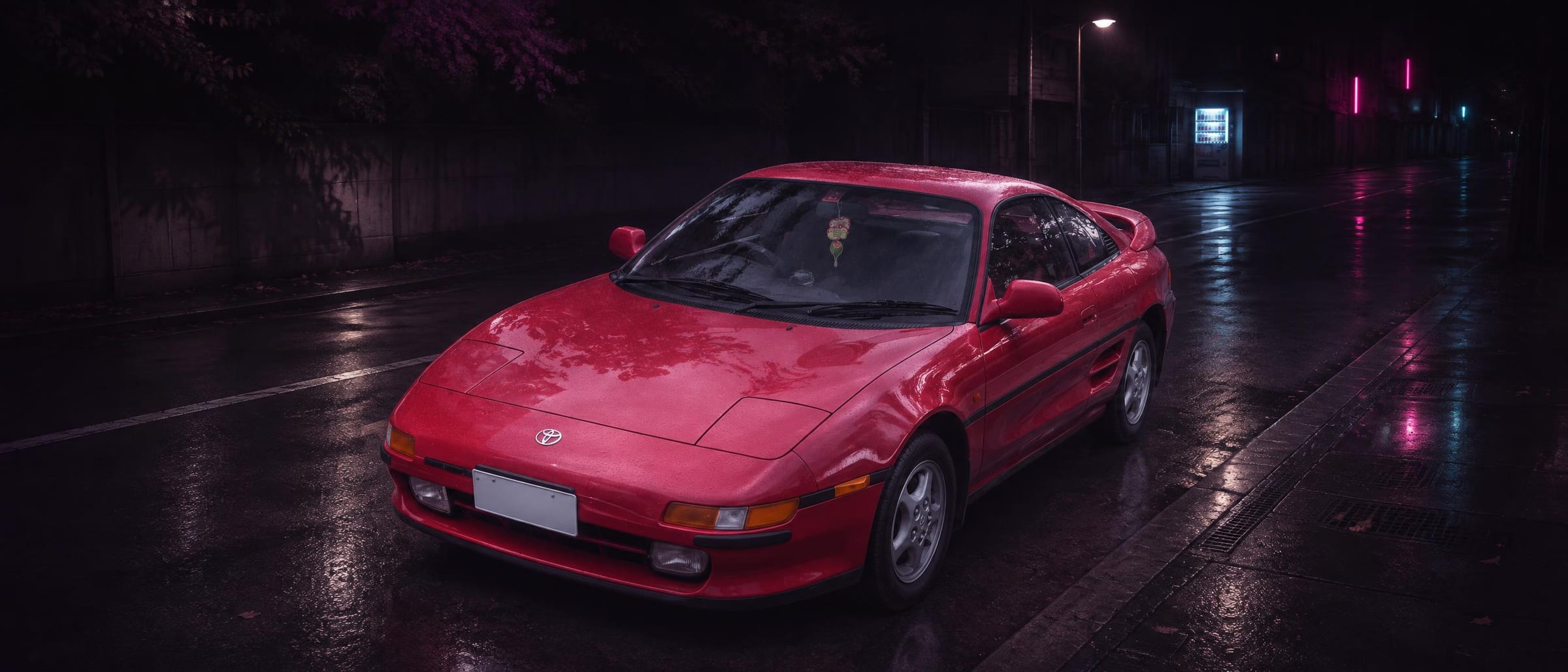
AI illustration based on a photo by FotoSleuth, CC BY 2.0, via Wikimedia Commons. Details may differ from the real car.

Toyota
Toyota MR2
The Toyota MR2 put the engine behind the driver at a price ordinary buyers could reach, across three generations: the AW11, the SW20 and the ZZW30. This page covers the history, sourced specs, tuning and body kits for each.
History
The first MR2, the AW11, arrived in 1984: small, sharp-edged and powered by the 4A-GE twin-cam four. A supercharged version followed.
The second generation, the SW20, came in 1989 and is the one most people picture. It was larger and rounder, and in turbo form it used the 3S-GTE. Toyota revised it several times over ten years, and the revisions matter: suspension and tyre changes altered how the car behaves at the limit.
The third generation, the ZZW30, went on sale in 1999 as an open-top car, sold in Japan as the MR-S. It dropped the turbo for a lighter, simpler approach and ran until 2007.
Specs
Japanese-market figures first. Export differences are noted where they exist. Every figure links to its source.
| Variant | Chassis code | Years | Engine | Displacement | Induction | Power (PS / hp) | Torque (Nm) | Drivetrain | Gearbox | Kerb weight (kg) | Source |
|---|---|---|---|---|---|---|---|---|---|---|---|
| MR2 G-Limited | AW11 | 1984 | 4A-GE | 1,587 cc | Naturally aspirated | 130 / 128 | 149 | Mid-engine, rear-wheel drive | 5-speed manual | 950 | [1][2] |
| MR2 G-Limited Supercharger | AW11 | 1986 | 4A-GZE | 1,587 cc | Supercharged | 145 / 143 | 186 | Mid-engine, rear-wheel drive | 5-speed manual | 1,070 | [1][2] |
| MR2 GT (Revision 3) | SW20 | 1993 | 3S-GTE | 1,998 cc | Turbo | 245 / 242 | 304 | Mid-engine, rear-wheel drive | 5-speed manual | 1,270 | [1][3] |
| MR2 G-Limited (Revision 5) | SW20 | 1997 | 3S-GE | 1,998 cc | Naturally aspirated | 200 / 197 | 206 | Mid-engine, rear-wheel drive | 5-speed manual or 4-speed automatic | 1,220 | [1][3] |
| MR-S S Edition | ZZW30 | 1999 | 1ZZ-FE | 1,794 cc | Naturally aspirated | 140 / 138 | 171 | Mid-engine, rear-wheel drive | 5-speed manual | 970 | [1][4] |
- A dash means the source does not state that value.
- Years show the model year of the car each source documents, not the length of the production run.
- Power in hp is converted from the PS figure the source gives.
- Rows citing carsensor.net are from a Japanese used-car catalogue, read one grade page per row. It gives torque in kg·m; the Nm figures are conversions.
- Rows citing Wikipedia are from a secondary source, and Wikipedia gives no citation of its own for most of those figures.
- Toyota’s own vehicle history site could not be read, so every row rests on secondary sources.
- The catalogue gives the supercharged engine as 145 PS. Wikipedia’s 147 PS is a conversion from 145 hp.
- The catalogue lists the SW20 by generation, not by revision. Its 245 PS and 200 PS grades match the 1993 and 1997 cars Wikipedia describes. The 1997 weight is for the manual car without the T-bar roof.
Spotted a figure you can correct, with a source? Email daansimpelaar6@gmail.com.
Tuning
The SW20 Turbo's 3S-GTE is the centre of most MR2 tuning, and it shares a family with the engines in the Celica GT-Four, so parts and knowledge cross over. The mid-engine layout brings its own questions: heat, access and what the chassis does when you add power. The AW11 and ZZW30 have their own well-trodden engine swap routes.
Most of what follows comes from tuners, parts makers and magazines rather than the carmakers, and several of those sources sell the parts they describe. Each point names its source. Power is given in the unit the source uses, and figures "at the wheels" are lower than figures at the engine.
- SW20: know the revision. CarThrottle, quoting MR2 specialist Fensport, counts three: Rev 1; Rev 2, from December 1991 to November 1993, with chassis changes that made the car friendlier; and Rev 3, from November 1993 to June 1996, with rear bracing, revised engines and 550 cc injectors in place of 440 cc. Retro Rides adds that the early rear tie rods were too short, and a 1992 update lengthened them by 90 mm and changed the rear toe. A second CarThrottle guide, written for the US market, dates the main change to late 1993: retuned rear suspension, a thicker front anti-roll bar and wider rear tyres. (sources 1, 2, 3)
- Snap oversteer is real. Fensport confirms the reputation, especially for Rev 1 turbo cars. Retro Rides puts about 56 percent of the weight over the rear wheels. (sources 1, 3)
- Turbo and boost. The 1990 to 1993 cars have the second-generation 3S-GTE, the 1994 to 1999 cars the third. (source 4) The early CT26 turbo is good for about 16 psi (1.1 bar), around 280 bhp; the later CT20b spools faster and takes about 19 psi (1.3 bar), with up to 300 bhp possible. (source 2) Fensport puts the stock turbo and internals at 280 to 300 bhp on a safe 1 bar, and says the injectors run out quickly; beyond that, forged internals and a hybrid turbo take the car to 350 to 400 bhp. (source 1) The factory overboost fuel cut is set low, so it has to be dealt with before boost goes up, and Drifted advises against running leaner than 12.0:1. (source 4)
- Heat. The cooling system holds 15 litres and has four bleed points, and trapped air leads to overheating and a failed head gasket. The catalytic converter sits in the turbo downpipe and can cook at sustained high speed. After hard driving, let the engine idle for three minutes. (source 2) The coolant hose owners call the "Hose From Hell" can burst at around 160,000 km (100,000 miles), and the heater hoses above the fuel tank crack at their brackets. (source 1)
- Ride height and alignment. The standard car sits high. Fensport fits Tein springs, 37 mm lower at the front and 38 mm at the rear, with polyurethane bushes, and keeps the standard dampers. The cars go out of alignment easily. (sources 1, 2)
- AW11: the supercharger. The 4A-GZE uses a Roots-type SC12 blower with an electromagnetic clutch. Its efficiency falls to the low 50 percent range at higher boost, and the factory intercooler holds it back. The usual way to more boost is an oversized crank pulley or a smaller blower pulley, after which the engine runs lean at low rpm unless the fuelling is changed. (source 5)
- Swap routes. AW11: the 20-valve 4A-GE from overseas Corollas of 1992 to 1998, practical only in this chassis and needing revs to make power, or the 3S-GTE turbo engine, a swap known as the "Mk 1.5". SW20: fitting a turbo engine to a non-turbo car is relatively easy. ZZW30: the 2ZZ-GE fits directly, and the mechanical and electrical work is relatively easy. (source 6)
- CarThrottle, Matt Robinson, "9 things you need to know before buying an SW20 Toyota MR2", updated 10 October 2024
- CarThrottle, "Used car buying guide: 2nd generation Toyota MR2 Turbo", updated 10 October 2024
- Retro Rides, Cliff Chambers, "Top tips for buying a used Toyota MR2 Turbo (1990-98)", 26 June 2025
- Drifted, "Toyota 3SGTE: the ultimate guide", 25 January 2023
- MR2 Wiki (community wiki), "Supercharger", updated 8 December 2009
- MR2 Wiki (community wiki), "Engine models", updated 22 December 2010
Body kits
The SW20's shape drew a wide range of kits, from subtle lip-and-skirt sets to wide-body conversions that change the car's whole outline.
Build examples
Documented builds, each credited and linked to where it was first shown. We describe them; the photos and the full story stay with the people who made them.
MR2
Owen’s K20 turbo MR2
A Honda K20 swap with a Precision 6466 turbo, quoted at 650 hp and revving to 9,200 rpm, in a car that looks mostly standard and keeps its factory brakes with no ABS, traction control or power steering. The article does not say which generation it is.
AW11
Loz Selly’s K20 AW11
Rescued from a barn where it had been used for airsoft target practice, then rebuilt over about three years in Shropshire around a K20A2 from a Civic Type R, with blended fibreglass arch extensions and 3SDM 0.05 wheels. The article gives no power figure.
Car Throttle, “How This AW11 Toyota MR2 Went From Wreck To K20-Swapped Riches”, by Matt Robinson
Unique builds
The ones that don't fit anywhere else. Engine swaps nobody asked for, body conversions, and ideas that should not have worked.
SW20
Marty Sweatt’s Typhoon
An SW20 with its wheelbase stretched by 260 mm to take a supercharged 4.2-litre Audi V8 mounted lengthways, driving through a three-speed automatic from an Audi 5000. Around 400 bhp, four years in the making.
Car Throttle, “This Stretched Toyota MR2 Is Powered By A Supercharged Audi V8”, by Matt Robinson
Keep going
Get an alert when this page gets new builds or kits.
One short email when something new goes live. Nothing else.
No newsletter. Unsubscribe with one click.