
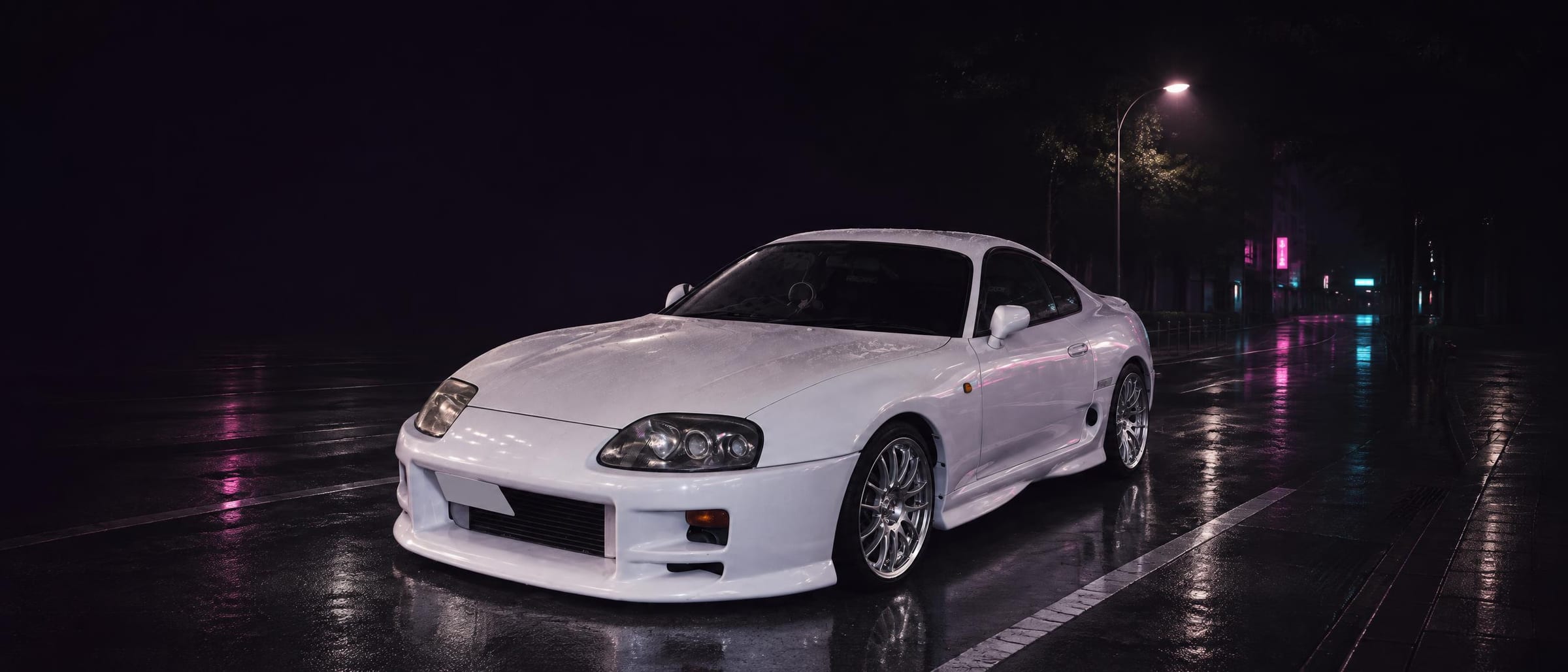
AI illustration based on a photo by Tokumeigakarinoaoshima, CC0 1.0, via Wikimedia Commons. Details may differ from the real car.

Toyota
Toyota Supra
The Toyota Supra A80 is the car that made the 2JZ-GTE famous, and the engine returned the favour. This page covers the Supra's history from its Celica beginnings, with sourced specs, tuning and body kits focused on the A70 and A80.
History
The Supra started in 1978 as a longer, six-cylinder version of the Celica. It became its own model with the A70 in 1986, which later gained turbocharged engines.
The A80 arrived in 1993. Toyota cut weight where it could and fitted the 3.0-litre 2JZ-GTE with sequential twin turbochargers. The car stayed on sale in Japan until 2002, by which time it had already left most export markets.
The name returned in 2019 on a car developed with BMW. That car is covered in the history here but is outside this page's detailed specs.
Specs
Japanese-market figures first. Export differences are noted where they exist. Every figure links to its source.
| Variant | Chassis code | Years | Engine | Displacement | Induction | Power (PS / hp) | Torque (Nm) | Drivetrain | Gearbox | Kerb weight (kg) | Source |
|---|---|---|---|---|---|---|---|---|---|---|---|
| Celica XX 2000 | MA45 | 1978 | M-EU | 1,988 cc | Naturally aspirated | 125 / 123 | 184 | FR | 5-speed manual or 4-speed automatic | — | [1][2] |
| Celica XX 2600 | MA46 | 1978 | 4M-E | 2,563 cc | Naturally aspirated | 140 / 138 | 184 | FR | 5-speed manual or 4-speed automatic | 1,180 | [1][2] |
| Supra 2.5 GT Twin Turbo R | JZA70 | 1990 | 1JZ-GTE | 2,491 cc | Twin turbo | 280 / 276 | 363 | FR | 5-speed manual | 1,520 | [1][3] |
| Supra SZ | JZA80 | 1993 | 2JZ-GE | 2,997 cc | Naturally aspirated | 225 / 222 | 284 | FR | 5-speed manual | 1,410 | [4] |
| Supra RZ | JZA80 | 1993 | 2JZ-GTE | 2,997 cc | Sequential twin turbo | 280 / 276 | 431 | FR | 6-speed manual | 1,510 | [1][4] |
| Supra Turbo (export) | JZA80 | 1993 | 2JZ-GTE | 2,997 cc | Sequential twin turbo | 325 / 321 | 427 | FR | 6-speed manual | 1,565 | [1] |
- A dash means the source does not state that value.
- Years show the model year of the car each source documents, not the length of the production run.
- Power in hp is converted from the PS figure the source gives.
- Rows citing carsensor.net are from a Japanese used-car catalogue, read one grade page per row. It gives torque in kg·m; the Nm figures are conversions.
- Rows citing Wikipedia are from a secondary source, and Wikipedia gives no citation of its own for most of those figures.
- Toyota’s own vehicle history site could not be read, so every row rests on secondary sources.
- No source read gives a weight for the Celica XX 2000. Wikipedia gives the whole first generation as 1,150 to 1,270 kg. It also gives the same torque for the 2.0 and the 2.6, as shown.
- The Celica XX 2600 weight is for the 2600G with the manual gearbox.
- The export car’s weight is Wikipedia’s figure for the turbo with the manual gearbox; Wikipedia does not say which market it applies to.
Spotted a figure you can correct, with a source? Email daansimpelaar6@gmail.com.
Tuning
The 2JZ-GTE's reputation comes from how much power its standard bottom end is reported to hold. This section sorts the documented from the repeated: what the engine takes as standard, what changes first, and what the gearbox and the rest of the car need to keep up.
Most of what follows comes from tuners, parts makers and magazines rather than the carmakers, and several of those sources sell the parts they describe. Each point names its source. Power is given in the unit the source uses, and figures "at the wheels" are lower than figures at the engine.
- How much the bottom end takes. The sources disagree. HP Academy calls 600 hp easy on stock internals and a sensible limit for an engine that is driven hard, with 800 hp possible once the main bearing caps, the first internal part to fail, are replaced. NZ Performance, a parts seller, is more cautious: 370 to 450 kW (about 500 to 600 hp) for a healthy stock engine with a proper tune. It adds that pump fuel runs out of octane before the engine runs out of strength, and that knock damages the rods and ring lands. (sources 1, 2)
- Japanese and export engines differ. Japanese cars have CT20 turbos with ceramic turbine wheels, which dislike high boost and ignition-cut limiters; US cars have CT12B turbos with steel wheels. Japanese cars also measure air with a MAP sensor and use 440 cc injectors, US cars an airflow meter and 550 cc injectors. (source 1)
- The ECU. The factory ECU cannot be reflashed, so tuning means a standalone or piggyback unit; a piggyback suits automatic cars. VVT-i, from mid-1997, limits how far the camshafts can be changed. (source 1)
- The sequential system, and going single. The handover from the first turbo to the second is the weak spot of the standard set-up, and its vacuum lines and actuators are prone to faults. The small turbos run out of breath at high power. A single turbo trades some low-rpm response for a much stronger top end, and needs a standalone ECU, larger injectors and usually a bigger fuel pump. (sources 1, 3)
- Wear items. Valve stem seals wear early and coil packs fail. (source 1)
Body kits
The A80's shape was already dramatic, so kits for it go one of two ways: quiet parts that sharpen the factory lines, or complete wide-body rebuilds that leave little of them.
JZA80
Varis wide body
Front fenders, side skirts, rear fenders and doors, with a Varis boot spoiler and air dam, as fitted to the Garage Revolver car.
Build examples
Documented builds, each credited and linked to where it was first shown. We describe them; the photos and the full story stay with the people who made them.
JZA80
Brian Okawa’s single-turbo Supra
Bought in Hawaii as a part-finished drag build and reworked for street response. The 2JZ-GTE is stroked to 3,353 cc with a PTE6768 turbo on E85; the article gives 905.7 hp at 31 psi on a Dynojet.
DSPORT, “Widebody Single-Turbo Toyota Supra JZA80”, by Richard Fong, 6 March 2014
JZA80
The Garage Revolver and Varis Supra
A 1995 car built in Tokyo as a show collaboration and first shown at Tokyo Auto Salon 2018. A Do-Luck 3.1-litre 2JZ with a single GReddy T88H-38GK turbo is quoted at 800 hp, under a Varis wide body on 19-inch Volk Racing TE37 Ultra wheels.
DSPORT, “800HP Varis Widebody Toyota Supra”, by Bassem Girgis, 30 April 2018
Unique builds
The ones that don't fit anywhere else. Engine swaps nobody asked for, body conversions, and ideas that should not have worked.
Keep going
Get an alert when this page gets new builds or kits.
One short email when something new goes live. Nothing else.
No newsletter. Unsubscribe with one click.