
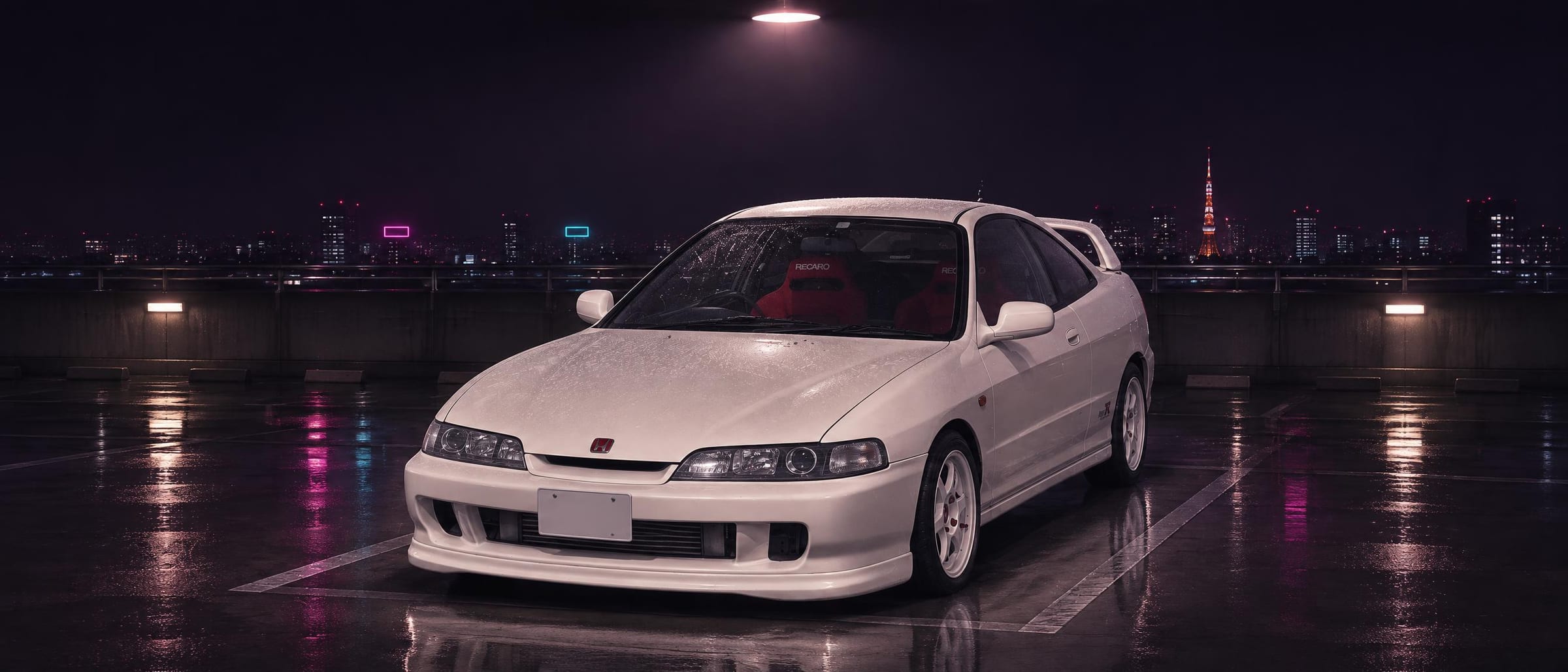
AI illustration based on a photo by Calreyn88, CC BY-SA 4.0, via Wikimedia Commons. Details may differ from the real car.

Honda
Honda Integra
The Honda Integra proved a front-wheel-drive car could be a serious driver's car, most of all as the DC2 Type R. This page covers the Integra's history, sourced specs, tuning and body kits, generation by generation.
History
The Integra began in 1985 as a sportier car above the Civic. The second generation, launched in 1989, carried the first production VTEC engine, the B16A.
The third generation arrived in 1993. In 1995 Honda added the Type R: a lighter, stiffer DC2 with a hand-finished B18C engine and a limited-slip differential. It is the version the model's reputation rests on.
The fourth generation, the DC5, followed in 2001 with the K20A engine and ran until 2006. In North America the Integra was sold under the Acura name, and the DC5 as the Acura RSX.
Specs
Japanese-market figures first. Export differences are noted where they exist. Every figure links to its source.
| Variant | Chassis code | Years | Engine | Displacement | Induction | Power (PS / hp) | Torque (Nm) | Drivetrain | Gearbox | Kerb weight (kg) | Source |
|---|---|---|---|---|---|---|---|---|---|---|---|
| Integra XSi | DA6 | 1989 | B16A | 1,595 cc | Naturally aspirated | 160 / 158 | 152 | FF | 5-speed manual | 1,080 | [2] |
| Integra Type R | DC2 | 1995 | B18C | 1,797 cc | Naturally aspirated | 200 / 197 | 181 | FF | 5-speed manual | 1,060 | [1][3] |
| Integra Type R | DC5 | 2001 | K20A | 1,998 cc | Naturally aspirated | 220 / 217 | 206 | FF | 6-speed manual | 1,180 | [1][3] |
- A dash means the source does not state that value.
- Years show the model year of the car each source documents, not the length of the production run.
- Power in hp is converted from the PS figure the source gives.
- Rows citing carsensor.net are from a Japanese used-car catalogue, read one grade page per row. It gives torque in kg·m; the Nm figures are conversions.
- Rows citing Wikipedia are from a secondary source, and Wikipedia gives no citation of its own for most of those figures.
- Honda’s own news archive refused access, so every row rests on secondary sources.
- The DC2 figures are for the three-door car at launch. Japanese Wikipedia gives the later cars 19.0 kgf·m (186 Nm).
Spotted a figure you can correct, with a source? Email daansimpelaar6@gmail.com.
Tuning
Integra tuning is engine tuning first. The B-series is among the most developed four-cylinder families there is, and the K-series that followed has become a common swap into the older cars. This section covers both, along with what the chassis wants: the Type R's factory changes are a good map of where to start.
Most of what follows comes from tuners, parts makers and magazines rather than the carmakers, and several of those sources sell the parts they describe. Each point names its source. Power is given in the unit the source uses, and figures "at the wheels" are lower than figures at the engine.
- What Honda changed for the Type R. The engine was hand-assembled, with polished ports, lighter connecting rods, stronger pistons, reshaped intake valves and a larger throttle body. (source 1) The body got extra spot welds, thicker metal around the rear suspension mounts, less sound deadening and a thinner windscreen, plus a limited-slip differential. (source 2) Japanese cars had a better 4-2-1 exhaust manifold, a smaller catalytic converter, a higher final drive and closer first to third gears. (source 3)
- Fuel and the ECU. The engine was designed for 100 RON fuel in Japan, and on lower-octane fuel some cars can detonate unless they are remapped or fitted with a piggyback ECU such as Hondata. Common engine upgrades are cold-air intakes, uprated engine mounts, a baffled sump and adjustable cam gears. (source 3)
- Known weak points. The B18C uses some oil even in good health; up to 1 litre per 1,600 km (1,000 miles) is not unheard of, so check it often. (sources 2, 3) Warm it up before using the VTEC range. (source 1) The factory oil pump can fail on a car that has spent its life at the top of the rev range, and the crank pulley is another known weak spot. (source 3) Second and third gear synchros wear with track use. (sources 1, 2, 3)
- Chassis. Worn bushes are common, especially the rear trailing arm bushes; polyurethane bushes and Bilstein B6 dampers are the usual replacements, and the dampers are due by about 97,000 km (60,000 miles). (sources 2, 3)
- Adding boost. 8020 Automotive says a B18 makes 200 to 250 hp at the wheels without the engine being opened, and its fairly low compression suits boost. It puts the next steps at 250 to 300 hp (a stronger bottom end and head gasket), 350 to 400 hp (forged internals) and around 400 hp (sleeved cylinders). (source 4)
- The K-series swap. The K20 and K24 are commonly swapped into the DC2 Integra, chosen for power, tuning potential and aftermarket support. The swap needs specific engine mounts, swap driveshafts, a wiring conversion harness, a way round the ECU immobiliser (a bypass or a Hondata K-Pro or standalone ECU), a cable shifter in place of the factory linkage, a different exhaust manifold, a relocated radiator and a new clutch line. Estimates run from £4,000 to £8,000, or about $6,000. (sources 5, 6)
- Octane, Matthew Hayward, "Honda Integra Type R (DC2) buying guide, history and review", 2 July 2024
- PistonHeads, Alisdair Suttie, "Honda Integra Type R (DC2): PH used buying guide", 10 May 2018
- Rush Magazine, John Bee, "The ultimate buying guide for the Honda Integra Type-R DC2", 7 July 2022
- 8020 Automotive, Austin Parsons, "Honda B18 engine guide", 8 November 2022, updated 30 December 2023
- Exoracing (parts seller), "The ultimate K-swap installation guide"
- SlashGear, Wilfred Nkhwazi, "5 things you need to know before K-series engine swapping your car", 17 December 2024
Body kits
Japanese and export Integras wore different front ends, so the first body change many owners make is a front-end conversion. Beyond that, kits range from Type R replica parts to full aero from the Honda specialists.
Build examples
Documented builds, each credited and linked to where it was first shown. We describe them; the photos and the full story stay with the people who made them.
Unique builds
The ones that don't fit anywhere else. Engine swaps nobody asked for, body conversions, and ideas that should not have worked.
Keep going
Get an alert when this page gets new builds or kits.
One short email when something new goes live. Nothing else.
No newsletter. Unsubscribe with one click.