
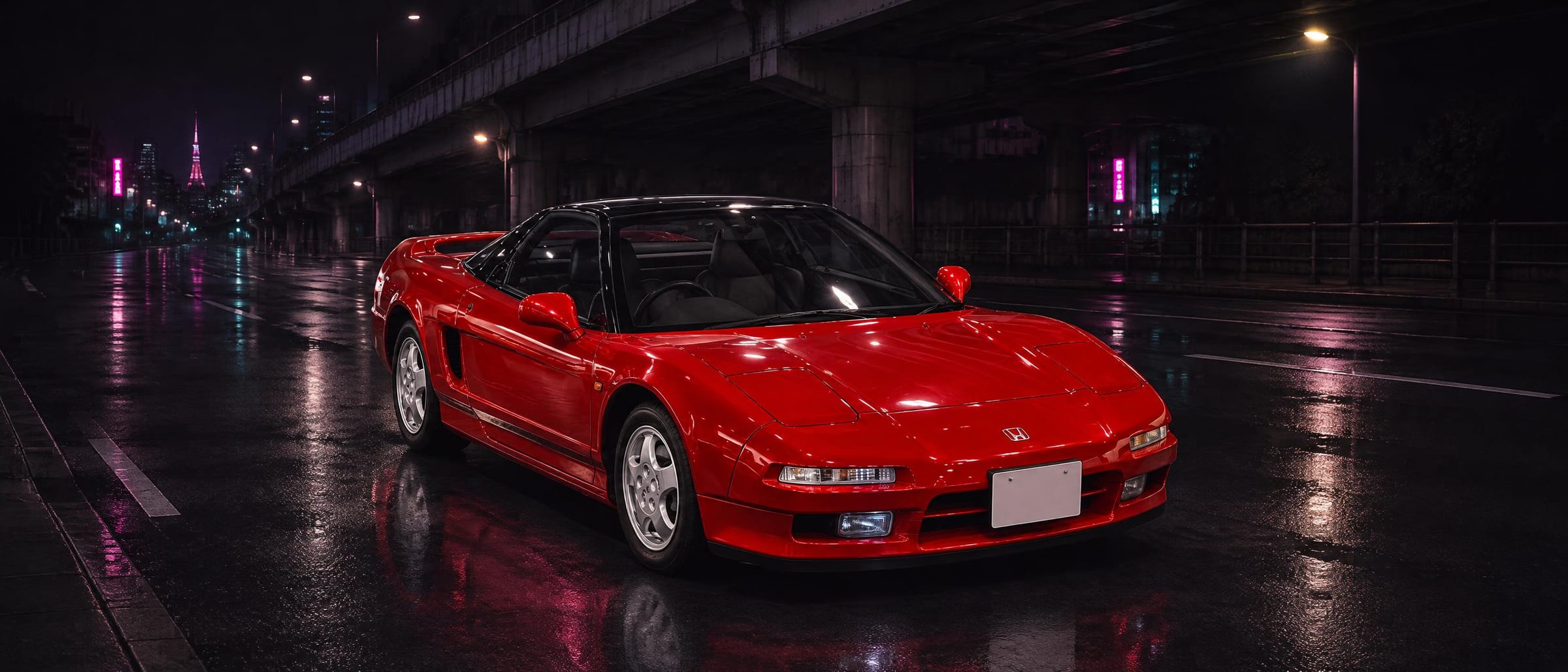
AI illustration based on a photo by 先従隗始, CC0 1.0, via Wikimedia Commons. Details may differ from the real car.

Honda
Honda NSX
The Honda NSX took on the mid-engine supercar with an aluminium body, a VTEC V6 and the idea that such a car could be driven every day. This page covers the NSX's history, sourced specs, tuning and body kits, focused on the original NA1 and NA2.
History
The NSX went on sale in 1990 with a 3.0-litre V6 mounted behind the seats and a body and chassis made of aluminium. Ayrton Senna, then driving for McLaren-Honda, took part in its development testing.
Honda refined the car for fifteen years. A lighter Type R came in 1992. A 3.2-litre engine and six-speed gearbox arrived in 1997 for manual cars, giving the NA2. A facelift at the end of 2001 replaced the pop-up headlights with fixed ones, and a second Type R followed in 2002. Production ended in 2005.
In North America the car was sold as the Acura NSX. The hybrid NSX of 2016 is part of the history here but outside this page's detailed specs.
Specs
Japanese-market figures first. Export differences are noted where they exist. Every figure links to its source.
| Variant | Chassis code | Years | Engine | Displacement | Induction | Power (PS / hp) | Torque (Nm) | Drivetrain | Gearbox | Kerb weight (kg) | Source |
|---|---|---|---|---|---|---|---|---|---|---|---|
| NSX (manual) | NA1 | 1990 | C30A | 2,977 cc | Naturally aspirated | 280 / 276 | 294 | Mid-engine, rear-wheel drive | 5-speed manual | 1,350 | [1][2] |
| NSX (automatic) | NA1 | 1990 | C30A | 2,977 cc | Naturally aspirated | 265 / 261 | 294 | Mid-engine, rear-wheel drive | 4-speed automatic | 1,390 | [1][2] |
| NSX-R | NA1 | 1992 | C30A | 2,977 cc | Naturally aspirated | 280 / 276 | 294 | Mid-engine, rear-wheel drive | 5-speed manual | 1,230 | [1][3] |
| NSX (manual) | NA2 | 1997 | C32B | 3,179 cc | Naturally aspirated | 280 / 276 | 304 | Mid-engine, rear-wheel drive | 6-speed manual | 1,350 | [1][2] |
| NSX-R | NA2 | 2002 | C32B | 3,179 cc | Naturally aspirated | 280 / 276 | 304 | Mid-engine, rear-wheel drive | 6-speed manual | 1,270 | [1][3] |
- A dash means the source does not state that value.
- Years show the model year of the car each source documents, not the length of the production run.
- Power in hp is converted from the PS figure the source gives.
- Rows citing carsensor.net are from a Japanese used-car catalogue, read one grade page per row. It gives torque in kg·m; the Nm figures are conversions.
- Rows citing Wikipedia are from a secondary source, and Wikipedia gives no citation of its own for most of those figures.
- Honda’s own news archive refused access, so every row rests on secondary sources.
- Power, torque, gearbox and weight are the Japanese-market figures from the catalogue grade pages. Wikipedia’s 274 PS and 294 PS are the export cars.
- The catalogue lists the 2002 NSX-R under the model code LA-NA1. NA2 is the code Wikipedia uses for the 3.2-litre cars.
Spotted a figure you can correct, with a source? Email daansimpelaar6@gmail.com.
Tuning
The NSX is tuned with more restraint than the turbo cars on this site. Many owners stay naturally aspirated and work on response, gearing and weight; others add a supercharger or turbo. This section covers both routes and what each costs the car.
Most of what follows comes from tuners, parts makers and magazines rather than the carmakers, and several of those sources sell the parts they describe. Each point names its source. Power is given in the unit the source uses, and figures "at the wheels" are lower than figures at the engine.
- What Honda built in. The C30A has titanium connecting rods, each about 190 g (roughly 30 percent) lighter, which Honda says raised the engine's maximum speed by about 700 rpm. The manual car's red zone starts at 8,000 rpm and VTEC switches over at 5,800 rpm. Compression is 10.2:1, and the engine was designed for 100 RON fuel. Honda chose not to turbocharge it because of the weight of intercooling, the heat to be managed and turbo lag. (source 1)
- The naturally aspirated route. One documented 1994 car shows how far it goes: bored out to 3,111 cc with 12.0:1 pistons, aftermarket rods and camshafts, and an HKS F-CON V Pro ECU, it made 345 hp at the hubs. It also ran a 4.4:1 final drive with a 1.5-way limited-slip differential, an oil cooler, a baffled sump and pillow-ball bushes to keep the alignment steady. (source 2)
- The supercharged route. A 1992 car with a Whipple twin-screw supercharger made 435 hp at the wheels on 9 psi (0.6 bar), but needed a custom intercooler, 650 cc injectors, an AEM ECU, an aftermarket radiator, a Japanese NSX-R gearbox with a 4.55 final drive and a triple-plate clutch; DSPORT notes that a supercharger takes power from the crankshaft and heats the intake air. (source 3) A restomod with a Magnuson TVS1900 supercharger and a liquid-to-air intercooler made 505 hp at the wheels on forged 9.4:1 pistons, keeping the factory titanium rods, with 1,050 cc injectors and the cooling system enlarged to 16 litres. (source 4)
- Known weak points. On early five-speed gearboxes, the circlip holding the countershaft bearing can snap; the affected serial numbers, J4A4-1003542 to J4A4-1005978, are on a sticker on the gearbox. (source 5) DSPORT says Honda issued a service bulletin for 1991 and 1992 US cars. (source 3) The NSX has 23 coolant hoses, a weak coolant mix corrodes the aluminium heads, and the aluminium engine mounts can fail, which shows as a knock when the engine is revved. (source 5)
- The 3.2-litre engine. The 1997 C32B brought larger intake valves, revised head gaskets, fibre-reinforced cylinder liners and larger rod bearings. (source 5)
- Honda, "C30A: NSX VTEC DOHC" engine technology page
- DSPORT, Richard Fong, "This street NSX is always ready for the circuit", 11 February 2016
- DSPORT, Brian English, "Twin-screw technology offers instant NSX boost to 435whp", 8 June 2016
- DSPORT, APEworks, "Big Hero 6: a restomod NSX thirty years in the making", 27 April 2026
- PistonHeads, Alisdair Suttie, "Honda NSX buying guide: powertrain", 2 March 2012
Body kits
Much NSX body work follows the factory: Type R parts, and conversions between the pop-up and fixed-headlight cars. Beyond that are the widened, race-inspired kits from the Honda specialists.
NA1
Marga Hills wide-body aero kit
As fitted, in modified form, to Mr. J’s NSX. The article does not itemise the parts.
NA1
ADVANCE Co. FLAT OUT aerodynamics
Bonnet, rear wing and side mirrors, as fitted to Susumu Shimbori’s NSX.
Build examples
Documented builds, each credited and linked to where it was first shown. We describe them; the photos and the full story stay with the people who made them.
NA1
Susumu Shimbori’s ADVANCE NSX
A 1990 car built by the owner of ADVANCE Co. in Yokohama without forced induction: a C30A taken to 3,110 cc with C32B heads and individual throttle bodies, for 343 whp. The article reports its Fuji Speedway lap falling from 2:20 as standard to 1:56.
DSPORT, “343 WHP Honda NSX”, by Richard Fong, 23 February 2021
NA1
Mr. J’s street and circuit NSX
A 1994 car from Kanagawa developed over 17 years and driven on the street in its track setup. The C30A is overbored to 3,111 cc with TODA internals for 345 whp, under a modified Marga Hills wide-body kit. The article lists a 1:55.322 lap at Fuji.
DSPORT, “This Street NSX is Always Ready for the Circuit”, by Richard Fong, 11 February 2016
Unique builds
The ones that don't fit anywhere else. Engine swaps nobody asked for, body conversions, and ideas that should not have worked.
Keep going
Get an alert when this page gets new builds or kits.
One short email when something new goes live. Nothing else.
No newsletter. Unsubscribe with one click.