
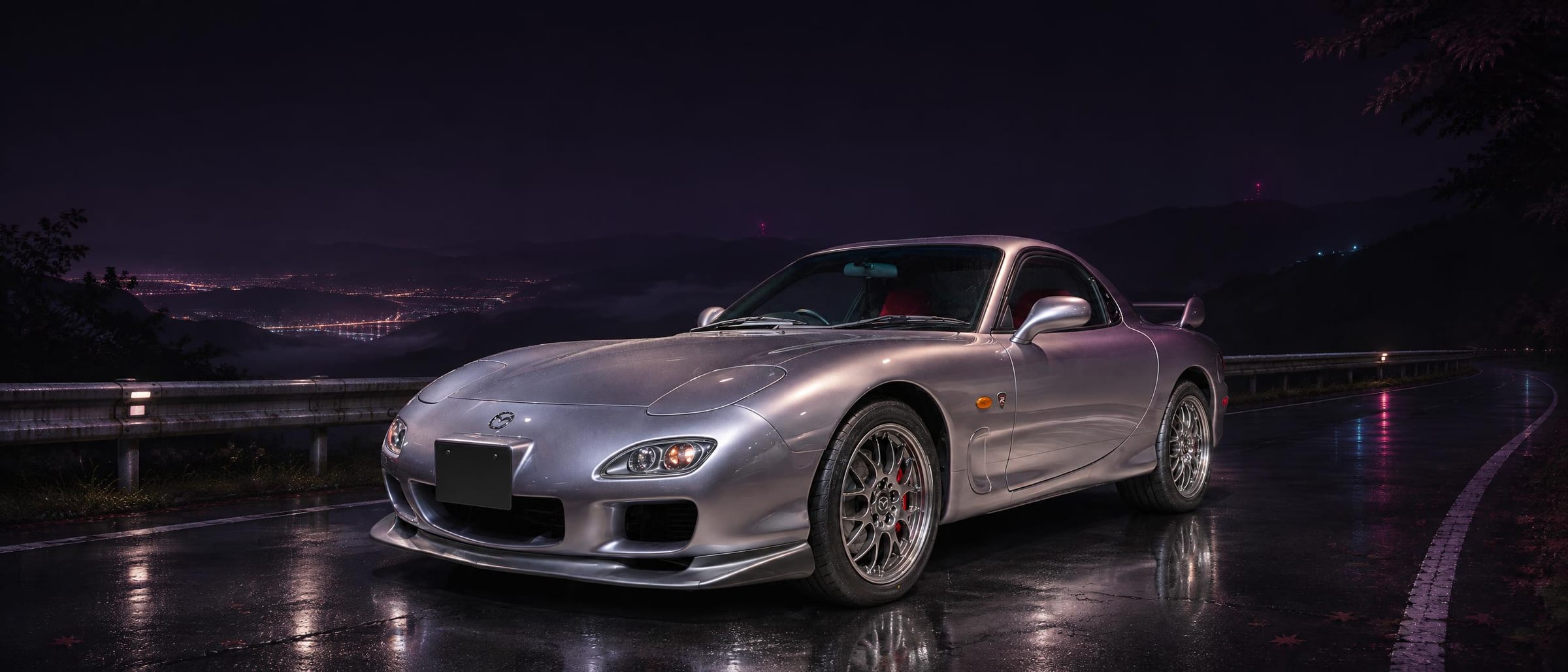
AI illustration based on a photo by Aos.1905, CC BY 4.0, via Wikimedia Commons. Details may differ from the real car.

Mazda
Mazda RX-7
The Mazda RX-7 is the rotary sports car: three generations, all powered by an engine nobody else would commit to. This page covers the RX-7's history, sourced specs, tuning and body kits, with the most detail on the FD.
History
The first RX-7 went on sale in 1978 as a light, simple coupe with a twin-rotor engine. The second generation, the FC, arrived in 1985 and brought the turbocharged 13B.
The FD followed in the early 90s. It was lighter than its rivals and used the 13B-REW with sequential twin turbochargers. Mazda kept developing it for the Japanese market through a series of revisions until production ended in 2002.
Behind the road cars sat Mazda's long commitment to rotary racing, which peaked with the 787B's win at Le Mans in 1991.
Specs
Japanese-market figures first. Export differences are noted where they exist. Every figure links to its source.
| Variant | Chassis code | Years | Engine | Displacement | Induction | Power (PS / hp) | Torque (Nm) | Drivetrain | Gearbox | Kerb weight (kg) | Source |
|---|---|---|---|---|---|---|---|---|---|---|---|
| Savanna RX-7 | SA22C | 1978 | 12A | 1,146 cc | Naturally aspirated | 130 / 128 | 162 | FR | 5-speed manual or 3-speed automatic | 1,005 | [1][2] |
| Savanna RX-7 Turbo | SA22C | 1983 | 12A | 1,146 cc | Turbo | 165 / 163 | 231 | FR | — | — | [1][2][6] |
| RX-7 GT Limited | FC3S | 1985 | 13B-T | 1,308 cc | Turbo | 185 / 182 | 245 | FR | 5-speed manual | 1,280 | [1][3] |
| RX-7 GT-R (facelift) | FC3S | 1989 | 13B-T | 1,308 cc | Turbo | 205 / 202 | 270 | FR | 5-speed manual | 1,250 | [1][3] |
| RX-7 Type R (Series 6) | FD3S | 1991–1993 | 13B-REW | 1,308 cc | Sequential twin turbo | 255 / 252 | 294 | FR | 5-speed manual | 1,260 | [1][4] |
| RX-7 Type RB (Series 8) | FD3S | 1999–2000 | 13B-REW | 1,308 cc | Sequential twin turbo | 265 / 261 | 294 | FR | 5-speed manual | 1,240 | [1][5] |
| RX-7 Type R (Series 8) | FD3S | 1999–2000 | 13B-REW | 1,308 cc | Sequential twin turbo | 280 / 276 | 314 | FR | 5-speed manual | 1,260 | [1][5] |
- A dash means the source does not state that value.
- Years show the model year of the car each source documents, not the length of the production run.
- Power in hp is converted from the PS figure the source gives.
- Rows citing carsensor.net are from a Japanese used-car catalogue, read one grade page per row. It gives torque in kg·m; the Nm figures are conversions.
- Rows citing Wikipedia are from a secondary source, and Wikipedia gives no citation of its own for most of those figures.
- No Mazda page with RX-7 specifications could be found. Power figures are Wikipedia’s; torque, gearbox and weight from 1985 on are from the catalogue grade pages.
- The 1978 torque is converted from 16.5 kgf·m. Its weight is the single figure Japanese Wikipedia gives for the whole first generation.
- No source read gives a gearbox or a weight for the 1983 turbo car. Its torque is the figure Wikipedia gives for the 165 PS 12A turbo engine.
- The Series 8 Type RS has the same engine as the Type R and weighs 1,280 kg.
- Wikipedia, "Mazda RX-7" (secondary source)
- Japanese Wikipedia, "マツダ・RX-7" (secondary source)
- carsensor.net catalogue, Mazda Savanna RX-7 grade pages (secondary source, in Japanese)
- carsensor.net catalogue, Efini RX-7 grade pages, 1991 to 1997 (secondary source, in Japanese)
- carsensor.net catalogue, Mazda RX-7 grade pages, 1997 to 2002 (secondary source, in Japanese)
- Wikipedia, "Mazda Wankel engine" (secondary source: 12A turbo torque)
Spotted a figure you can correct, with a source? Email daansimpelaar6@gmail.com.
Tuning
A rotary is tuned differently from a piston engine, and the advice that works on a 2JZ can ruin a 13B. This section covers what the engine needs to live, the single-turbo conversion many FDs end up with, porting, and the cooling work that comes before any of it.
Most of what follows comes from tuners, parts makers and magazines rather than the carmakers, and several of those sources sell the parts they describe. Each point names its source. Power is given in the unit the source uses, and figures "at the wheels" are lower than figures at the engine.
- Check the engine before anything else. A compression test reading of 7 to 8 bar is good; lower readings point to worn apex or side seals, and a specialist rebuild costs around £3,000. Oil use of up to a quarter of a litre per 1,600 km (1,000 miles) is normal, so check the level at every fill, and change the oil every 4,800 km (3,000 miles). (source 1) HP Academy says the factory apex seals are good but brittle and can shatter, especially when carbon builds up in an engine that is never driven hard. The 13B is very sensitive to detonation, misfires and lean running, and running hot even briefly can wreck it. (source 2)
- Cooling before power. The coolant air separator tank can split, and for track use PistonHeads recommends an uprated tank and radiator. (source 1) 8020 Automotive recommends silicone in place of the rubber vacuum and coolant hoses, removing the expansion tank, and an aftermarket radiator and twin oil coolers; it also says heat makes the wiring harness brittle. (source 3)
- The sequential twins. The second turbo comes in at 4,500 rpm. Under-bonnet heat kills the solenoids that control the handover, so the turbos come in erratically, and it hardens the rubber pipes. (source 1) HP Academy calls the system prone to failure. (source 2) Many owners convert to one larger turbo, from around £3,500 in 2017. (source 1)
- The ECU. The factory ECU cannot be reflashed; HP Academy recommends a standalone ECU with staged injection and split ignition control. (source 2) PistonHeads names the Apexi Power FC as the usual first step. (source 1)
- How much the engine takes. The sources disagree. HP Academy says a 13B-REW makes upwards of 400 hp at the wheels before it needs opening up, with a street port, the right turbo and supporting work, and its own FD made 420 hp at the wheels on factory ports; beyond that it needs a stud or dowel kit, porting and rotor clearancing. 8020 Automotive claims 700 hp at the wheels with no internal changes, and puts the stock turbos at about 350 hp at the wheels on 15 psi (1.0 bar). (sources 2, 3)
- Porting and seals. In order of severity: street port, half-bridge, bridge, extended bridge (which means sealing the water jacket) and peripheral port, the last with a very rough idle and less low-down torque. The standard carbon apex seals suit naturally aspirated and moderately powerful turbo engines; ceramic seals shatter when they fail, and steel seals bend instead, though some wear the housings. Removing the oil metering pump means premixing oil with the fuel. (source 2)
- Gearbox. The fourth-to-fifth shift can be awkward, and most owners live with it. (source 1)
- PistonHeads, Alisdair Suttie, "Mazda RX-7 buying guide: powertrain", 16 October 2017
- HP Academy (tuning school), Peter Kelly, "Everything you need to know about the Mazda 13B rotary"
- 8020 Automotive, Jake Mayock, "5 most common Mazda 13B REW engine problems", 13 February 2021, updated 20 November 2024
Body kits
The FD may have attracted more aero than any other car of its era, much of it from specialists who work on almost nothing else.
FD3S
Vertex Ridge wide body kit
Front bumper spoiler, side steps, rear bumper spoiler, 35 mm front and rear aero fenders and canards, sold as a six-piece set. Listed by the retailer TF-Works.
FD3S
Vertex body kit
Listed by the retailer TF-Works for 1993 to 1995 cars. The listing does not itemise the parts.
FD3S
ORIGIN Labo. Stylish full kit
Hand-laid fibreglass. Listed by the retailer TF-Works; the listing does not itemise the parts.
Build examples
Documented builds, each credited and linked to where it was first shown. We describe them; the photos and the full story stay with the people who made them.
Unique builds
The ones that don't fit anywhere else. Engine swaps nobody asked for, body conversions, and ideas that should not have worked.
FD3S
Han’s Veilside Fortune RX-7
One of the two surviving Veilside Fortune wide-body cars from the film Tokyo Drift, owned in the UK since 2008. The kit adds more than 200 mm of width; the 13B-REW is close to standard at around 280 bhp, and the article stresses it is a show car, not a drift car.
Keep going
Get an alert when this page gets new builds or kits.
One short email when something new goes live. Nothing else.
No newsletter. Unsubscribe with one click.