
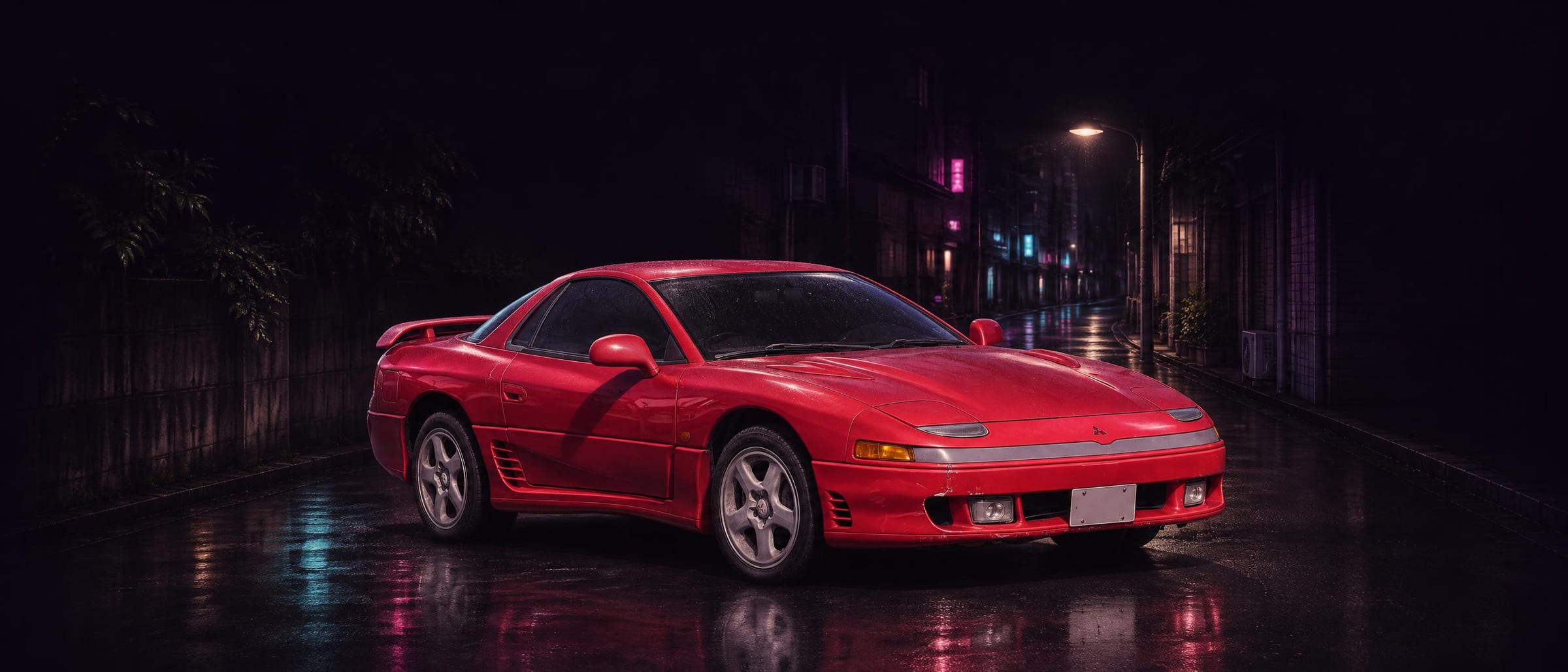
AI illustration based on a photo by Cutlass, CC0 1.0, via Wikimedia Commons. Details may differ from the real car.

Mitsubishi
Mitsubishi 3000GT
The Mitsubishi 3000GT, sold in Japan as the GTO, was the car that got everything: twin turbos, all-wheel drive, four-wheel steering and aero that moved on its own. This page covers its history, sourced specs, tuning and body kits.
History
Mitsubishi launched the GTO in Japan in 1990 and sold it abroad as the 3000GT. It was built around a 3.0-litre V6 from the 6G72 family, and the top version, the VR-4, added twin turbochargers and all-wheel drive.
It was a showcase for the technology of its time. The VR-4 carried four-wheel steering, electronically controlled suspension and active aerodynamics, with a front air dam and rear spoiler that changed position at speed.
In North America the car was also sold as the Dodge Stealth, built alongside it with different bodywork. A Spyder version with a retractable hardtop followed for the American market in the mid-90s. Production ran, with facelifts, until 2000.
Specs
Japanese-market figures first. Export differences are noted where they exist. Every figure links to its source.
| Variant | Chassis code | Years | Engine | Displacement | Induction | Power (PS / hp) | Torque (Nm) | Drivetrain | Gearbox | Kerb weight (kg) | Source |
|---|---|---|---|---|---|---|---|---|---|---|---|
| GTO Twin Turbo | Z16A | 1990 | 6G72 | 2,972 cc | Twin turbo | 280 / 276 | 417 | Full-time 4WD | 5-speed manual | 1,700 | [1][3] |
| GTO SR | Z15A | 1995 | 6G72 | 2,972 cc | Naturally aspirated | 225 / 222 | 275 | 4WD | 5-speed manual | 1,610 | [3] |
| 3000GT (Europe) | — | 1992 | 6G72 | 2,972 cc | Twin turbo | 286 / 282 | 407 | 4WD | 5-speed manual | 1,730 | [2][4] |
| 3000GT VR-4 (North America) | — | 1991 | 6G72 | 2,972 cc | Twin turbo | 304 / 300 | 417 | 4WD | 5-speed manual | 1,725 | [2][5] |
| 3000GT VR-4 (North America) | — | 1994 | 6G72 | 2,972 cc | Twin turbo | 324 / 320 | 427 | 4WD | 6-speed manual | 1,695 | [2][6] |
- A dash means the source does not state that value.
- Years show the model year of the car each source documents, not the length of the production run.
- Power in hp is converted from the PS figure the source gives.
- Rows citing carsensor.net are from a Japanese used-car catalogue, read one grade page per row. It gives torque in kg·m; the Nm figures are conversions.
- Rows citing Wikipedia are from a secondary source, and Wikipedia gives no citation of its own for most of those figures.
- No source read gives a chassis code for the export cars.
- The GTO SR is shown for 1995, the first year the catalogue lists that grade. Wikipedia gives it as 228 PS; the catalogue’s 225 PS is used here.
- The 1994 VR-4 weight is Wikipedia’s. Ultimate Specs gives 1,725 kg for the same car.
- Mitsubishi Motors, "Car History": GTO, launched October 1990
- Wikipedia, "Mitsubishi 3000GT" (secondary source)
- carsensor.net catalogue, Mitsubishi GTO grade pages (secondary source, in Japanese)
- Ultimate Specs, "Mitsubishi 3000GT 3.0 V6", 1992 (secondary source)
- Ultimate Specs, "Mitsubishi 3000GT VR-4", 1990 to 1994 (secondary source)
- Ultimate Specs, "Mitsubishi 3000GT VR-4", 1994 to 1997 (secondary source)
Spotted a figure you can correct, with a source? Email daansimpelaar6@gmail.com.
Tuning
The twin-turbo 6G72 responds well to the usual breathing and boost work, but the 3000GT asks more of its builder than most rivals: the engine bay is tight, the car is heavy, and the drivetrain has known limits. This section sets out what holds and what doesn't, with sources.
Most of what follows comes from tuners, parts makers and magazines rather than the carmakers, and several of those sources sell the parts they describe. Each point names its source. Power is given in the unit the source uses, and figures "at the wheels" are lower than figures at the engine.
- Weight comes first. An early VR-4 weighed around 1,720 kg (3,800 lb), and the Spyder close to 1,860 kg (4,100 lb). Every upgrade below works against that. (source 1)
- The turbos. They are small, spin fast and sit in a crowded engine bay where heat builds up, and the labour to replace them is the expensive part. A stock pair should last 160,000 to 240,000 km (100,000 to 150,000 miles). Mitsubishi itself raised boost from 10 to 12 psi (0.7 to 0.8 bar) for 1994. (source 1)
- The timing belt is not optional. The 6G72 is an interference engine. The belt, tensioners and water pump are due every 97,000 km (60,000 miles), sooner if the history is unknown. (sources 1, 2)
- The drivetrain is the real limit. Both Getrag gearboxes, the five-speed to 1993 and the six-speed from 1994, have their own failure points at higher power, and replacements have become hard to find. Output shafts have twisted on hard launches, the synchros may last only 64,000 km (40,000 miles) if the car is shifted hard, and the gearboxes need regular fluid changes. The 1991 to 1993 VR-4 transfer case was the subject of a recall. CarThrottle's advice on boost: raise it at your own risk. (sources 1, 2)
- The electronics. In the US, the active aero and the electronically controlled suspension were dropped for 1995. On earlier cars, an ECS stuck in one mode or a flashing warning light usually means the control unit in the back has failed. (source 1)
Body kits
The 3000GT changed face several times from the factory, so many owners start by swapping between years. Beyond that, the era's aero makers produced full kits for it.
Build examples
Documented builds, each credited and linked to where it was first shown. We describe them; the photos and the full story stay with the people who made them.
Z16A
Jared Holt’s 1999 VR4
Bought standard in 2012 and kept looking that way. On the original block, with a pair of upgraded Kinugawa turbos and E85, the article gives 575 whp and 500 lb-ft at 24 psi on a Dynojet.
DSPORT, “575 WHP Mitsubishi 3000GT VR4”, by Bassem Girgis, 8 June 2021
Unique builds
The ones that don't fit anywhere else. Engine swaps nobody asked for, body conversions, and ideas that should not have worked.
Get an alert when this page gets new builds or kits.
One short email when something new goes live. Nothing else.
No newsletter. Unsubscribe with one click.