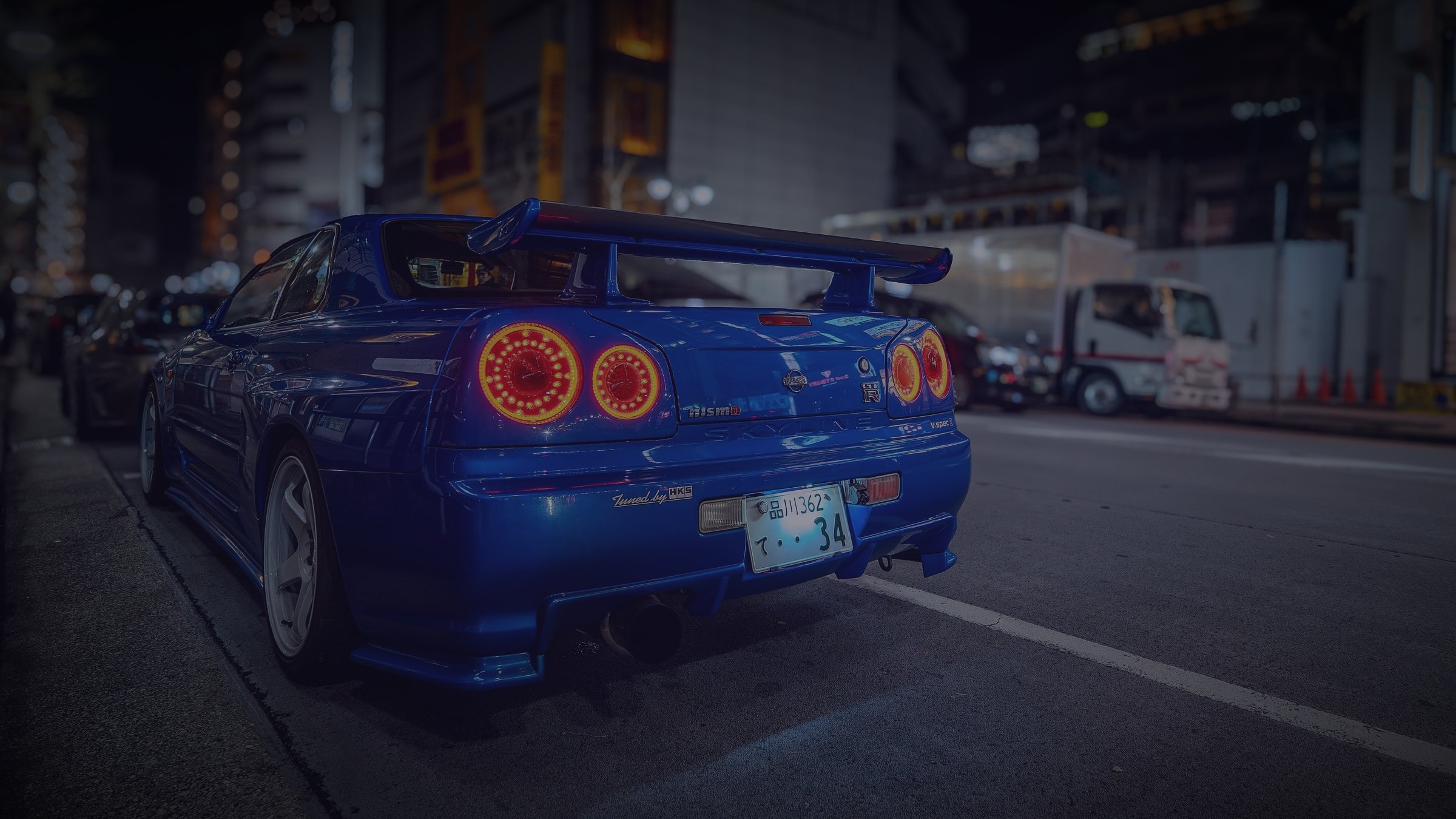
Nissan
Nissan Skyline GT-R
The Nissan Skyline GT-R came back in 1989 as the R32 and spent the next thirteen years as the benchmark.
Photo: David Kernan, CC BY 4.0, via Wikimedia Commons. Colour graded.

Articles
The RB26 vs 2JZ argument has run for thirty years and will outlive us all. Both are twin-turbo straight-sixes with iron blocks, both were built with more strength than their advertised power needed, and each has things the other does better. This article looks at why, starting with how each engine was designed.
Nissan built the RB26DETT to win in Group A touring cars (sources 3, 4). Group A rules multiplied a turbocharged engine's capacity by 1.7. Wikipedia says the R32 GT-R was first planned with a 2.4-litre engine for the 4,000 cc class, and that Nismo then chose 2.6 litres and the 4,500 cc class, though it marks that last step as needing a citation (source 1). By our arithmetic, 2,568 cc times 1.7 is about 4,370 cc, inside the larger class. 8020 Automotive tells the origin differently, as the 2.0-litre RB20DET bored and stroked (source 3). The engine went on sale in 1989, in the R32 GT-R (source 3).
Toyota's 2JZ-GTE arrived in 1991 in the Aristo saloon and became the Supra RZ's engine in 1993 (source 2). HP Academy says Toyota's aim was an engine to rival the RB26, able to take far more power in motorsport without giving up durability (source 5).
A cast-iron block with an aluminium head, two camshafts and four valves per cylinder (sources 1, 3, 4). Bore 86 mm, stroke 73.7 mm, 2,568 cc (source 1). Instead of one throttle, it has six, one for each cylinder (sources 1, 4, 6). Two turbochargers work in parallel, not in sequence, with ceramic turbine wheels; Wikipedia's text calls them T25-type and its summary box T28-type (sources 1, 3). There is no variable valve timing (sources 3, 4, 6). Nissan rated it at 280 PS at 6,800 rpm and 36 kg·m (353 Nm) at 4,400 rpm (source 1).
The documented weak points start with oiling. On early engines, the part of the crankshaft that drives the oil pump was machined too narrow, which led to pump failure at high rpm; Wikipedia says the wider drive was fitted from the third series of the R32 on (sources 1, 3). The crankshaft vibrates between 7,000 and 8,000 rpm (source 1), and Drifted cites fibre-optic observation of it shaking above 7,200 rpm (source 6). 8020 Automotive adds weak pistons, misfiring at high rpm and failing airflow meters (source 3). Nissan's own N1 version replaced the ceramic turbine wheels with steel ones for strength (sources 1, 3).
Also a cast-iron block with an aluminium head (source 2). HP Academy adds that the block is closed-deck, with seven main bearings, a forged crankshaft and oil jets under the pistons (source 5). Bore and stroke are both 86 mm (sources 2, 5). The two turbochargers work in sequence, a system Toyota developed with Hitachi (source 2). Japanese cars had CT20 turbos with ceramic turbine wheels and 440 cc injectors; export cars had CT12B turbos with steel wheels and 550 cc injectors (sources 2, 5). Variable valve timing, VVT-i, arrived in 1997 (sources 2, 5). In Japan the Supra RZ was rated at 280 PS (source 7); Toyota documented 320 hp for North America and Europe (source 2).
HP Academy's list of weak points: the main bearing caps are the first internal part to fail on a standard engine; the changeover from one turbo to both is troublesome; the Japanese ceramic turbos can be fragile; valve stem seals wear early; coil packs fail; and the head can crack in serious use (source 5).
Both start with iron blocks (sources 1, 2). Wikipedia credits the RB26's reputation for strength to its iron block and forged internals (source 1), and 8020 Automotive notes its forged steel I-beam rods (source 3). HP Academy points to the 2JZ's closed deck and forged crank (source 5). Iron has a cost: DSPORT and Drifted both note how heavy the RB26's block is (sources 4, 6).
Most of these figures come from tuners and magazines, and most do not say whether they are measured at the engine or at the wheels, or on what fuel. Where a source says, we say.
RB26DETT. Tomei, which makes turbochargers for it, puts the standard pistons at about 500 PS and says the connecting rods should be replaced above about 550 PS (source 8). 8020 Automotive is more cautious: the pistons often fail beyond 400 hp and the rods are good to around 450 hp (source 3). DSPORT says the standard turbos run out at 400 hp at the wheels, and that the block itself has supported more than 800 hp at the wheels (source 4). Drifted warns of failure at around 30 psi (2.1 bar) and 8,000 rpm (source 6).
2JZ-GTE. HP Academy calls 600 hp easy on standard internals with factory reliability, 800 hp possible with aftermarket main bearing caps, and 1,000 hp possible at a heavy cost in engine life; for a car driven hard and often, it suggests 600 hp (source 5). NZ Performance, which sells parts, is more cautious: 370 to 450 kW (about 500 to 600 hp) for a healthy standard engine with a proper tune (source 9).
On these sources, the 2JZ-GTE's bottom end holds more power on standard parts, and its known problems are mostly around it rather than in it: the main caps, the turbo changeover, seals and coils. The RB26's limits come sooner, from the pistons, the oil pump drive and the crank's vibration at high rpm. In return, the RB26 brings a design made for Group A, six throttles and a shorter stroke, while the 2JZ brings more capacity and a closed deck. Which suits depends on the car around it and the power you want; the figures above are where to start.
Nissan
The Nissan Skyline GT-R came back in 1989 as the R32 and spent the next thirteen years as the benchmark.
Photo: David Kernan, CC BY 4.0, via Wikimedia Commons. Colour graded.
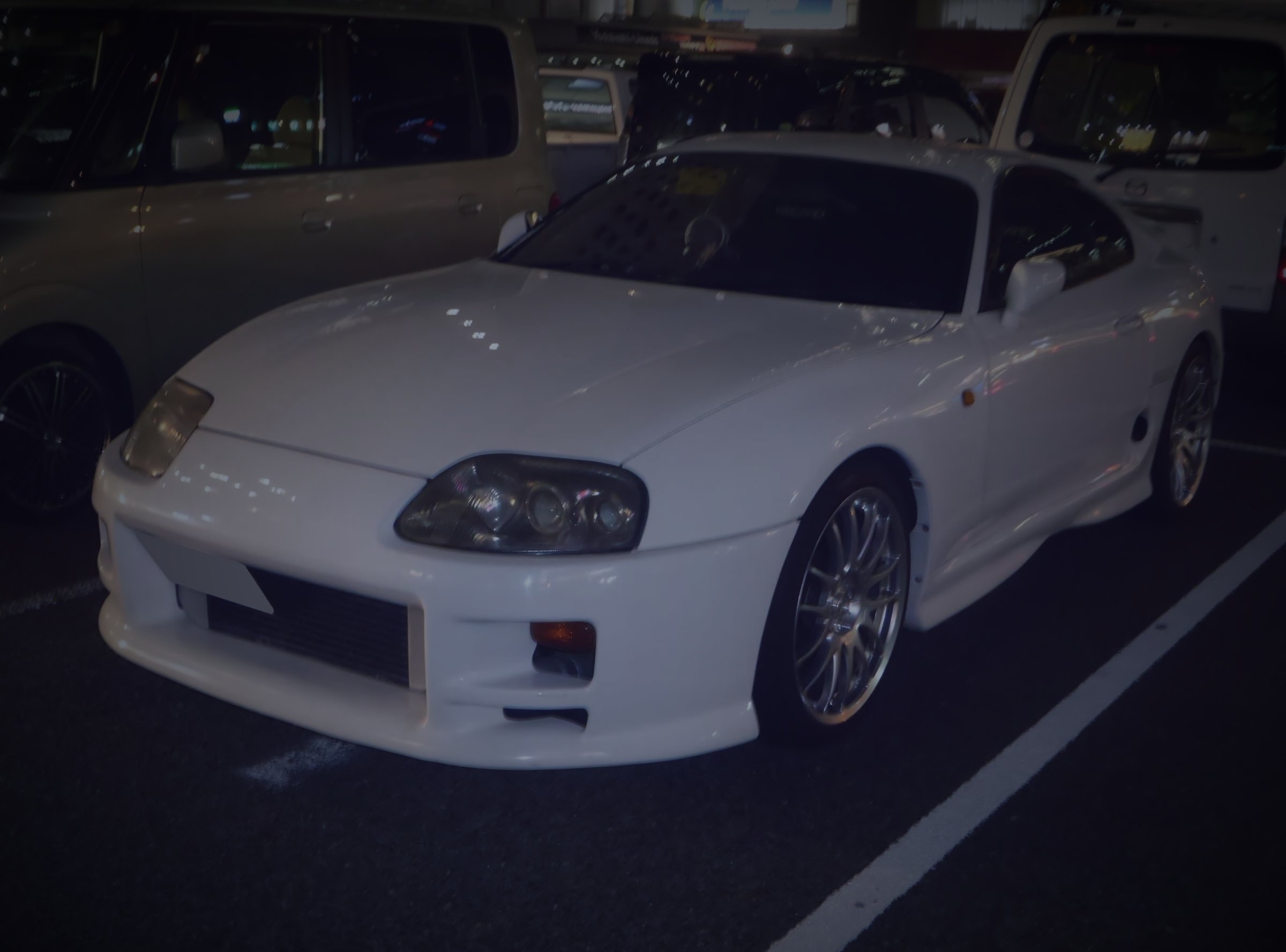
Toyota
The Toyota Supra A80 is the car that made the 2JZ-GTE famous, and the engine returned the favour.
Photo: Tokumeigakarinoaoshima, CC0 1.0, via Wikimedia Commons. Colour graded.
One short email when something new goes live. Nothing else.
No newsletter. Unsubscribe with one click.

